Dark the Night
and Pigeon the Owl
Hello. This post is about Death & Birds.
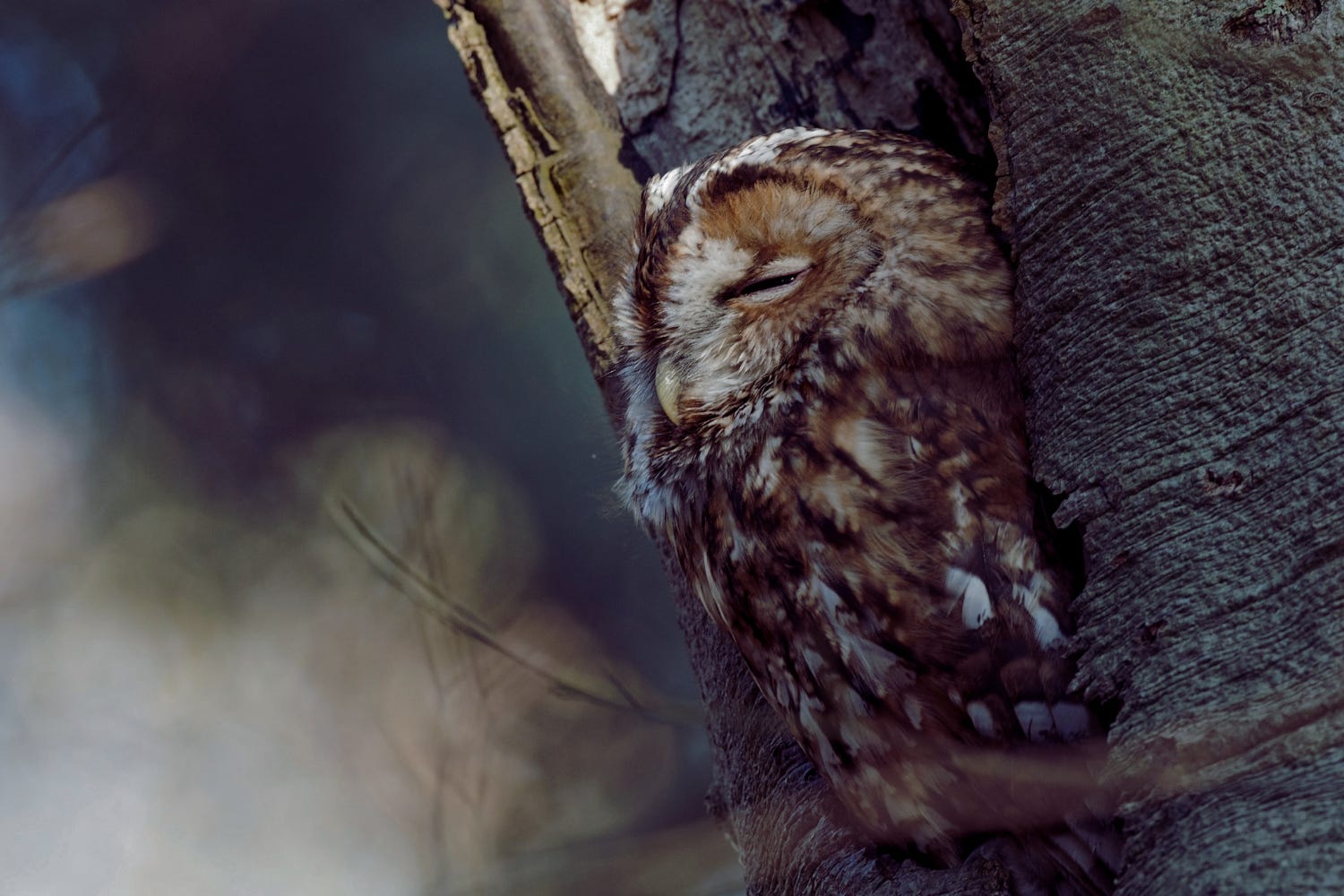
A couple of years ago a Tawny Owl came into the rescue centre. She was found orphaned, and had been hand-reared by a pair of well-meaning members of the public. When Pigeon (the Owl) arrived she believed wholeheartedly that she was human and had no idea that she was, in fact, a Bird of prey. Upon first being introduced to other Tawny Owls she was terrified, clinging to the wildlife manager for dear life and refusing to look the creatures that she so resembled in the eye. Owls are particularly prone to imprinting. At the rescue centre, baby Owls are fed using tweezers concealed within an Owl hand-puppet; their human carers masked by mirrored visors, all to ensure the Owls imprint only upon their own Owl-ness. Over time, Pigeon, through gentle and persistent proximity, began to remember her true self and, eventually, she relaxed around her kin. I wonder whether I was in fact raised by Birds, and my unease around human beings will one day wear off. At the end of the season, Pigeon was released back into the wild along with the Tawnys whom she had once so feared. Back into a world that retreats as the light withdraws from the day; but not she—for the night is hers, and the dark thick with potential.
When I was little it seemed to be that every other story began with a child being orphaned. That tragedy would then be mitigated by an often magical turn of events which would propel them into a world of adventure, enchantment and belonging. I can understand the heavy lean on the trope; it elegantly rids the story of parents who might interfere with the plot, while also providing a darkness against which the eventual triumphs may shine—but it sets the bar awfully high for the actual orphans out there. I spent a significant amount of my younger years tolerating the rather grey landscape of being parentless among the parented and having to deploy such sterile, bureaucratic phrases as “legal guardian” when handing in permission slips, because I was convinced that something fairly spectacular awaited on the horizon, ready to propel me into my own enchanted narrative and balance the universal scales. I appreciate the entitlement that exists in a belief that one is owed a cosmic debt. Thankfully, I have since come to appreciate that I am owed exactly nothing, that even my waking this morning was an extraordinary gift; but try telling that to an eight year old. When I hit double figures, I grew concerned. The payoff was taking its time. When I turned thirteen, I allowed myself to admit that it was not, nor had it ever been, coming. Loss was not a downpayment on some future consolation. It was just loss. When, shortly after, Class A drugs sauntered onto the scene I quite naturally looked at them, shrugged, and thought “They’ll do”. Because while they were certainly no Hagrid, or Giant Peach or wolf pack, they served to at least alter the landscape.
I think of Pigeon most evenings, as our local Tawny weaves his way from across the river to the Birches, then to the Ash, eventually coming to land in the Apple tree outside our bedroom. Silent, but for the call he floats across the night, towards his love, a field away. I think of how we have been hand-reared by a culture that has reflected back to us a distorted image of ourselves; leaving us with beliefs that we are lacking and faulty. That we must consume, and dominate, and compete, lest we be discarded, humiliated or forgotten. We imprint upon these false narratives, and are discouraged from remembering our true selves.
Scattered points of light only resolve into a constellation when enough distance is gained to see the whole sky, and from where I stand now, I can see the shape of mine. No debt was repaid, nor consolation delivered, but, like Pigeon, a slow, persistent proximity to my kin—to Death, to Birds, to nature and to the dark—prompted a remembering. The enchanted world I’d obsessively scanned the horizon for had, indeed, never been coming; because it was always there. I had been born into it, but it took the holy business of Death, and the wild perfection of Birds, to pierce the narratives that had blocked the view.
We in the northern hemisphere sit in the years nadir, cradled by the longest night. This hallowed darkness is not punishment nor problem to be solved by the dawn. It is—as any seed, or star, or unhatched Bird will tell you—a condition for becoming. The seed does not endure the dark earth; it requires it. The star does not suffer the nebula; it is forged there. Everything that knows how to become itself does so away from the light. And if we permit ourselves to remain in the dark long enough for our eyes to adjust, we might see what it is that wants to be born.
Yours in aimless flight…
We’ve been hand-reared by a culture that taught us to malign death, to see it as enemy rather than kin. The Deep End is an invitation to unlearn that imprinting—a 6-module self-paced course for those ready to remember a truer relationship with mortality. You can use code SOLSTICE30 for 30% off until January 1st 🎁
Death & Birds will return the weekend of January 10th as I'm taking an extra week over the holidays for some much needed rest. Thank you all so much for joining me here this year. May your days be peaceful, and full of simple delights.
Love,
Chloe


I so look forward to my time with your words. The wisdom and truth and beauty they weave, and I delight when they bring in things I have said for myself, though sometimes I say them more harshly, less eloquently. And then your gentleness washes over me and I feel more gentle with myself, and so learn more gentleness. Thank you for you Chloe. Sending much love.
Dear Chloe, the Universe has spoken to you and the Universe is speaking to me in a similar way, with similar themes in the music of the words of human hearts, and I suspect in the hearts of all things animate and inanimate.
In particular I have been meditating on death as the precursor to life. In the religious tradition which cradled me I learned these words of Jesus: “Unless a kernel of wheat falls to the ground and dies, it remains only a single seed, but if it dies, it bears much fruit.” And a relationship that has been long-standing is dying; I have come to see that it must die.
It has been a long journey through a very dark valley that has brought me to this place. I had just finished writing down some thoughts about death and love in the context of this pain. I had walked away from my laptop and then sat down again. I happened to check my inbox and saw your email and I listened to and read your post.
So take heart and be encouraged that you are indeed a healing person. If it is true, as is said in the therapeutic world, that abused people abuse, then it is also perhaps more profoundly true that healed and healing people heal.
You are on the path of healing and I am so very thankful for the courage that prompted you to begin writing and the skill and precision and beauty with which you do so.
Thank you and happy holidays, my friend.