Keening
a hope-giving thing
Hello. This post is about Death & Birds.
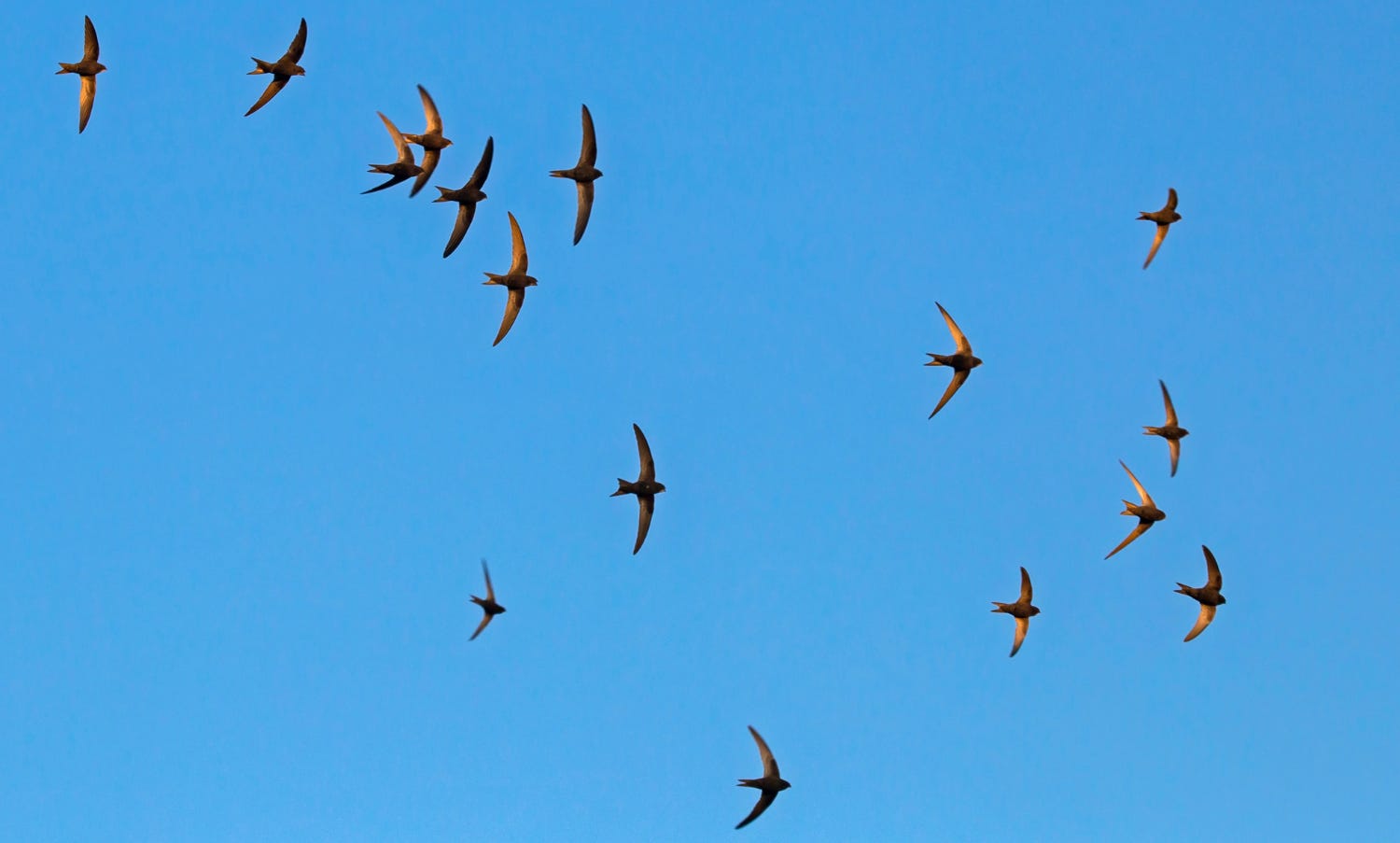
When I was young, I would sometimes walk to the churchyard and lay on the grass next to my mother’s grave. The boundaries between self, ground, bone, now, and then, all become rather permeable in certain places, and this was one of them. At times I’d have the vague sense of someone watching me from a distance, and I wonder whether perhaps it was me, here, in the future. Once, an elderly man (who, in hindsight was probably in his fifties) came and asked me if I was alright. I sat up, answering that I was, and he asked if he might sit with me a while. I obliged him, and he went on to share that his daughter was buried in the churchyard, having died many years ago, as a baby. We sat together quietly in our longing, beneath a sky scored by the dark bodies of a hundred Swifts. Their cries, like wind navigating narrow gaps, became the keening that neither I nor this gentleman were afforded. And now, it is June, and the Swifts have again returned—though fewer, and fewer, with every passing year. The sky no longer filled, only dappled—how it, too, must long for what it’s lost.
Statistics are hands, pointing in the direction of unfolding extinctions, and while they make legible the raging ecocide, figures cannot capture the splendour, the genius, nor the ruthless beauty of the individual beings who are victims of it. A 68% decrease in population over the last twenty years, becomes something else entirely once a single Swift wafts your hair back as she builds the strength in her wings. The hundreds of millions of Sparrows lost in the last few decades were each once nestlings, like the ones who gummily latch onto my fingertips as I feed their insatiable siblings. These numbers land as though I myself am being ripped from root and sky. They break my heart into a thousand Starlings, who murmurate longingly over the newly developed grasslands they once called home.
Recently, my brother pointed out a Bird, “Oh look, a Bullfinch!”, he said, excitedly. To which my six (going on thirty) year old niece rolled her eyes and, seemingly exhausted by her father’s incompetence, countered, “Daddy, that’s a Chaffinch”. The pride that flooded my body saw me grow a foot taller, right then and there. Watching this exquisite little being come to know and love her avian kin is a hope-giving thing. At a time when optimism ebbs from my shores, she makes me question whether the architects of environmental destruction are as unstoppable as they appear, or whether those who dare look—and then dare fall in love—might hold a kind of power that is yet to be reckoned with. After all, protection is love condensed into a force field—and her love, like mine, is ferocious. It is a Bear, ready to sink her teeth into the necks of those who would bring her cubs harm, while those same teeth softly carry their warm little bodies gently to the den. May she never learn to temper it.
Life is a single breath, taken and then returned, and that devastating uniformity is what makes each one so precious. The sociopathic hierarchies our culture has inherited were invented by a people taught that they were separate from, and likely condemned by, the very thing which had created them—and in response to their disenfranchisement they built a ladder, and dominated every rung they perceived as beneath them; because the sense of superiority masked the pain of disconnection. But, like any masked thing, the fact of its existence remains and, whether engaged with or not, pain always finds a way to be expressed. Ecocide, then, is the logical conclusion to this severance—if that which created us will not love us, better to kill it, than feel the pain of its refusal. Ecocide is deicide is suicide. It is our collective response to feeling orphaned, and not knowing how to be with the grief of it. The tragedy, of course—beside the mountains of dead and dying, and the silence where once there was birdsong—is that it was never even true. That we have always belonged, more completely than we could bear, but that we were handed a set of goggles many generations ago, and we’re still wondering around thinking they’re our eyes.
My love for the living world has, over the years, seen my compassion for the human species become negligible. The irony there being that misanthropy is, essentially, self-hatred. That in a world so deeply interconnected, hatred of anything is hatred of everything, and in this way I contribute to the issue. But, when I consider the unabated, frankly insane destruction carried out by my own species as in fact being the behaviour of a psyche made mad by grief—by an unmetabolised orphaning—I can actually make some sense of it. I can’t excuse it, not for a moment, but I edge toward understanding it. And from there I am less compelled to write off my species, entire. From there, I can ask if they are alright, and whether I might sit with them, a while.
Yours in aimless flight…
Friends, I wanted to share a book I’ve fallen in love with and which I had on my mind while I was writing the above. Robert Macfarlane and Jackie Morris’s The Book of Birds: A Field Guide to Wonder and Loss is a really stunning blend of natural history, art, poetry, and activism. Their foreword says that it asks not “What is that bird?” but “Who is that bird?” which is something I think about an awful lot. Hopefully the pair behind the book won’t mind me sharing some images from it. I opted for some of the Birds mentioned in this fortnights post, but it’s bursting with all manner of winged beings who are ruthlessly beautiful, like the book itself.


I was hovering over the heart to like this post, as I wanted to communicate that it had touched me, but don't think the heart symbolises sufficiently the wide and deep range of thoughts and emotions and thoughts that after this, and all your posts, arise in me. Beautiful and poignant and hopeful. Thank you.
You put such beautiful words to what I feel / think all the time. Thank you.