some impossible thing
a blackbird, a horse, a shell
Hello. This post is about Death & Birds.
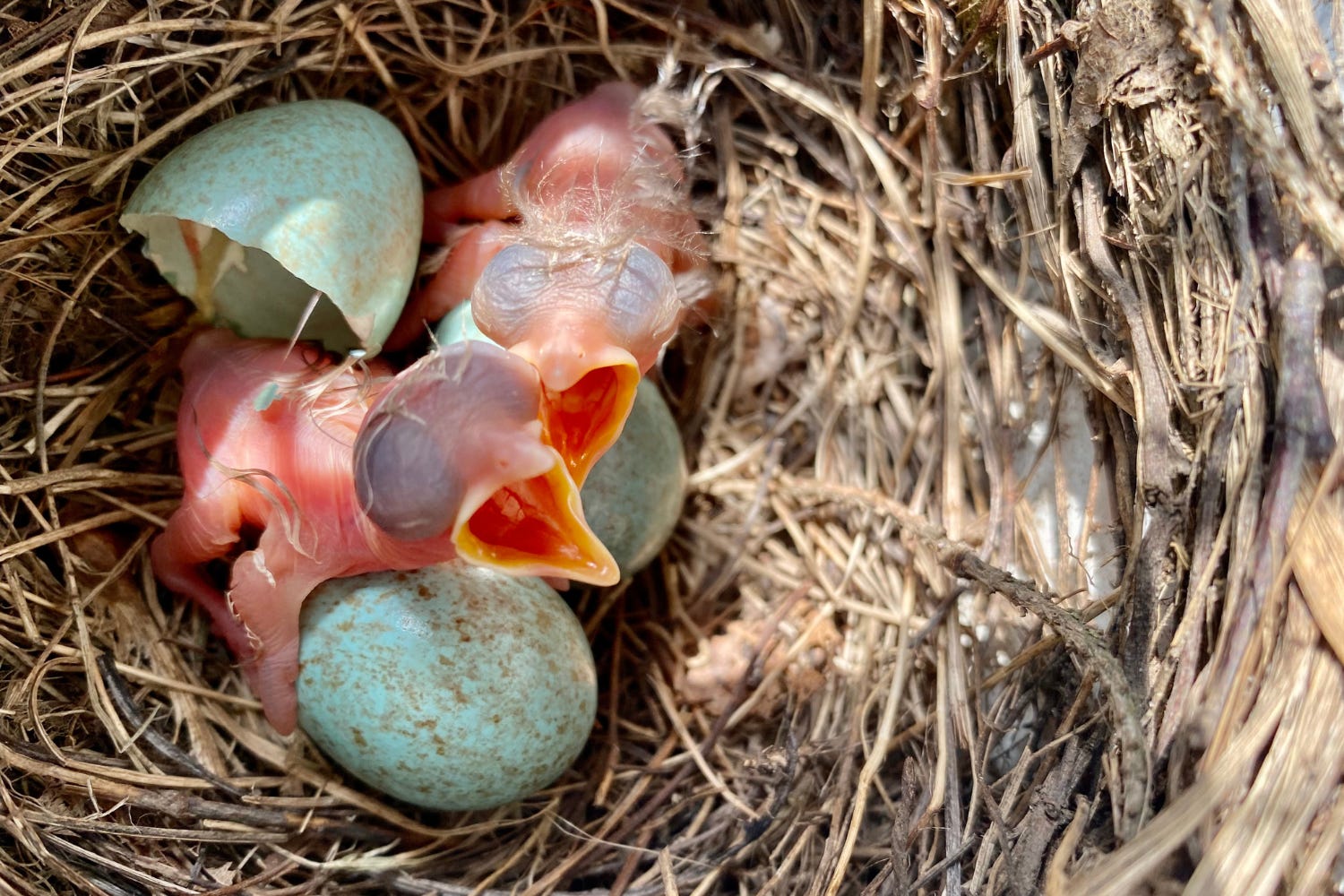
Over the years, I have experienced the distinct joy of witnessing various little Birds emerge from their shells. A pinprick of a hole marking intention, cracks forming, the first breach of the beak, and the gradual appearance of damp feather and pink skin. It is, as with any birth, a long and arduous process. I’ve often tried to imagine how it must be for the hatchling themselves; to reach the point of growth where the thing that formed to protect them has simply become too small, and, in order to live, one must fight their way out of it. It would seem that life favours this pattern, one where an integral step in the growth of a living thing is its meeting the hard edge of its own armour, and either suffering the struggle of the breakthrough, or ceasing to participate in the endless unfurling upon which life insists. Perhaps, then, I do have some vague understanding of the hatchling’s experience. Whenever I have found myself pressed up against some seemingly immovable force preventing my continued becoming—whether grief, resistance, addiction, or fear—and I have fought my way out, through the hard shell of the thing, I too have surfaced soft, raw, and unsteady, but eager to be fed by the world, and to orient towards my place in it.
This season, at the rescue centre, I’ve had the extraordinary privilege of joining the small team of people who bottle feed the Deer fawns. I was shocked, at first, by just how tiny they are—and how stomach-churningly perfect. Most of them are newborn Fallow Deer (think Bambi) but the Roe fawn, Pierre, is even smaller, barely 10 inches tall. Preventing imprinting is paramount, and the babies must learn the heartbreaking truth that humans are best avoided, so as soon as they are able they will feed from a bottle rack, but while they’re learning, one or two of us—dressed in overalls to mask our scents, and totally silent so they don’t associate human sounds with food—join them in the fawn-shed each mealtime. I had braced myself for it being an arduous task, imagining that much coaxing be required, but, because I go on to tend the baby Birds, I’ve only given the first feed of the day; and, first thing, the fawns are most enthusiastic. They squeak like dog toys, smell like vanilla, and have no concept of personal space. While feeding two, with a bottle in each hand, the others climb up and run their soft little curious mouths over any exposed skin—namely my neck and ears. It is shockingly intimate, and the silence only adds to the intensity of it. One by one, after feeding, they curl into a circle and drift to sleep. On finishing, I sprinkle some rose petals for them. Because that’s their favourite snack. Because they are literal cherubs. So sweet the fleeting experience, that when I leave the shed and continue on with the morning’s tasks, I sometimes wonder whether it even happened. Confirmation exists in how soft I am rendered. How their exquisite vulnerability awakens my own. Life continually offers me opportunities to have my heart broken—and I gladly take each one. Returning, like the tide, to the shores of deeply loving that which may well not survive.
Earlier this week I went straight from the fawns into the baby Bird unit, where I saw that one of the Blackbirds was not herself. She was a young fledgling, fresh out of the nest, who had been catted and brought in two days prior. She’d a small wound on her wing, but no other obvious injuries, so she joined a small gang of other Blackbirds. That day, though, she stopped eating, and began to breathe heavily. I put her in an incubator, for some warmth and some quiet, but I could see that her eyes were becoming distant, and soon it became clear that she was actively dying. Her Death throes began, and were particularly violent. She stretched, and arched, head and wings all pinning backwards, as though her heart were trying to leave her chest. She’d suddenly go limp, and I’d release the breath I’d been holding; and then, it would start again. It went on for 45 minutes. I think, sometimes, that love is like a Horse: large, majestic, full of power, and needing to run. It’s a magnificent beast, but it’s one that, at times, we need to temper. As I watched this sweet Bird, my Horse flared its nostrils and paced the room, restless, agitated, desperate to act—but allowing it to would have meant intervening in this unstoppable thing. There are times when restraint is not the absence of love, but rather the maturation of it. It looks like reining the Horse close and whispering “Wait, love. We have to wait.” Between the Blackbird in her dying and I in my witnessing, there was no shortage of suffering in that room. The least I could do was hold on to what was mine—to ensure that my love did not bolt for the door, and in the doing make her dying about me.
Hatching is an endurance test that last many hours, and sometimes days. It’s exhausting work that requires thousands of individual pecks, and the struggle is visible throughout. Should someone decide to intervene, to take the struggle from the Bird and peel back the shell themselves, the Bird will die—because the struggle is not incidental. Each peck builds muscle required for the Bird to thrive. And not all Birds survive hatching, but a Bird relieved of its struggle arrives in the world loved into helplessness. The resistance of the shell is the making of those who break through it.
I wonder, at times, whether Death is a shell. Whether dying may be akin to hatching, to breaking through some impossible thing in order that we might spread our wings. If, indeed, it is, how gracious of life to offer before us so many chances to practice.
Yours in aimless flight…


Absolutely beautiful.
Thank you Chloe. Your sheer strength to stay and witness the passing 'through' of the tiny blackbird to another world speaks volumes and as you said, not bolt for the door as it wasn't about you.
I am always amazed how all of our living 'World' here, has been 'designed'(?)such that it clearly includes the necessity for very distinct and difficult processes in order to achieve, have, or become a life, yet also to lose a life. Whether the being is human, animal, plant or other.