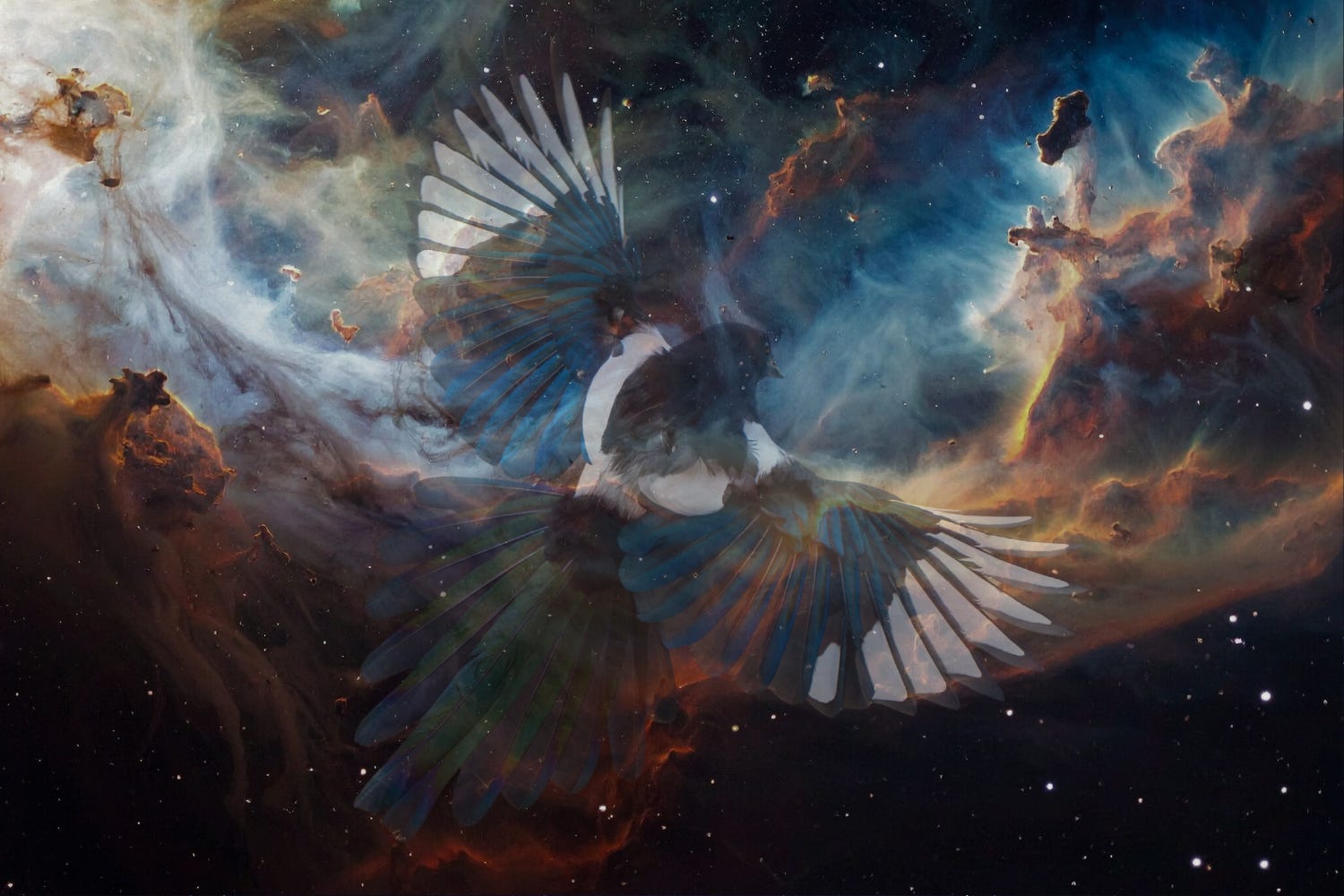
the water that Death swims in
the field in which we are held
Hello. This post is about Death & Birds.
It may come as a surprise to exactly no one, that I love baby Magpies. It goes without saying, of course, that I love all Birds, of all ages, the world over—but the soft descending trill of a baby Magpie sends a weakening through my body. They chirrup, and something in my cells recognises them, as though kin. We become tuning forks resonating across the unbridgeable distance between species. Perhaps this is a kind of love. I once helped care for a baby Magpie, who was about six days old when we met. I named him Jasper, in honour of the green jasper feathers he would one day grow, and he was the laziest Magpie I’d ever known. Typically, at his age, the mere hint of the day’s first feed would prompt an enthusiastic, elongated neck and cavernous gaping beak, but this fellow needed to be coaxed with forehead strokes and gentle words of encouragement. He worried me, at first, until it became clear that he was simply not a morning Bird and that, as far as he was concerned, showing any enthusiasm before 8am was embarrassing.
There is, naturally, a percentage of orphaned Birds who come to the rescue centre during baby season that do not live to see release as juveniles—and each one makes the deliverance of those who do all the more exultant. Jasper was with us for nearly six weeks, during which time he flourished, grew said jasper feathers, and even began greeting the day at dawn. In the outdoor aviary he would bound over in a series of hops, wings a flutter, squeaking eagerly, and eventually become irritated when I’d go to clean his messy beak; a sure sign he was becoming a teenager. When the time came to hand him back to the wild, he left along with six other Magpies of a similar age. In the Olde English nursery rhyme ‘One for Sorrow’, seven Magpies portends “a secret, never to be told”—which, given the wild mystery to which they were returned, seemed rather fitting.
Baby Bird season is a frenetic time, intense, demanding, tiring and often stressful. It is also a time that is firmly encased in love. There are times when I’ll kneel in the grass of the outdoor aviaries, so a small team of fledgling Magpies or Crows can bounce over to be fed, and everything stills. All that is not this moment, quiets. And in that quietude, I sense a quality to the negative space around us. Animate. Pulsing, almost. The dark matter. The field in which we are held. The water in which all matter, and life, and Death, swim.
With the world as it is, I keep seeing photographs of explosions, and so often there are blurred outlines of Birds mid-flight in the foreground. These beings with no concept of war, only a concept of must-fly-away. I think of the Birds who are nesting, and offer a prayer for those who are pinned to their nestlings by something far older and far stronger than war. Perhaps I should be ashamed of the fact that, whenever conflict breaks out, my first thought is “oh, the Birds, oh, the Dogs” and oh, all the beings who are pure, innocent consequence of the psychopathy of war. The damage done to children, and to children not yet born, and to children yet conceived, unfathomable—and yet the consideration of this somehow fails to enter the rooms in which the decisions are made. The very rooms where men bow their heads in circles of prayer, morality lifted from the toy chest of play costumes and just as quickly discarded. How far love feels from these places.
And yet.
I am made perpetually furious by the unabashed destruction of this age, and yet I believe it possible that it plays out, that it has always played out, within a field of all pervasive love. I believe that love may well be watching alongside the great many of us who are aching, and that she aches with us in unison—our aching connected to and by her. I believe she presses herself against the face of every terrified child, and every terrified soldier, just as she forces herself against the eyeballs of the men who give the orders that strike packed schools while she screams “look at me, LOOK AT ME”, and they avert their gaze. She the wave and particle, the observer and observed. She the container that must hold even that and those most antithetical to her—she who makes space for creaturely freedom, even when that freedom festers into atrocity. She the womb that lovingly contains it all...and so, perhaps she is consciousness, or perhaps she is God, or perhaps these are all words for exactly the same thing: that which is infinite enough to contain its own contradiction without collapsing. That which can hold the atrocity of war and the sublimity of birdsong in one singular breath, and, somehow, not break.
Yours in aimless flight…
Spring is here again, and how better to meet it than by befriending your mortality — and through it, the beautiful, cyclical nature of all life. Use code SPRING30 before midnight on March 29th for 30% off The Deep End - a self-paced course on turning toward Death, and finding life there.


Goodness, through so much of this piece I was whispering to myself, “I feel that too”. When I see bombs explode my thoughts also drift to: the animals, the breastfeeding mothers, the orphaned children.
I loved so much that Love was a her. I too have spent many a season with orphaned animals - in my case newborn orphaned kittens - and have revolved my time around cycles of Love and healing and release. Indeed, there is nothing more maternal than an absorption of love. Thank you for your stunning reflection, as always.
Oh, dear Chloe, I feel bathed in this golden-lighted reminder that love is the field that holds us all. That love can “hold even that and those most antithetical to her.” I saw one of those photos yesterday and thought of you — blurred just-airborne birds foregrounding bomb-clouds behind buildings. And I thought, oh! The birds! What must they think?
You know that memorial in London to the animals of war? It’s gutting.