

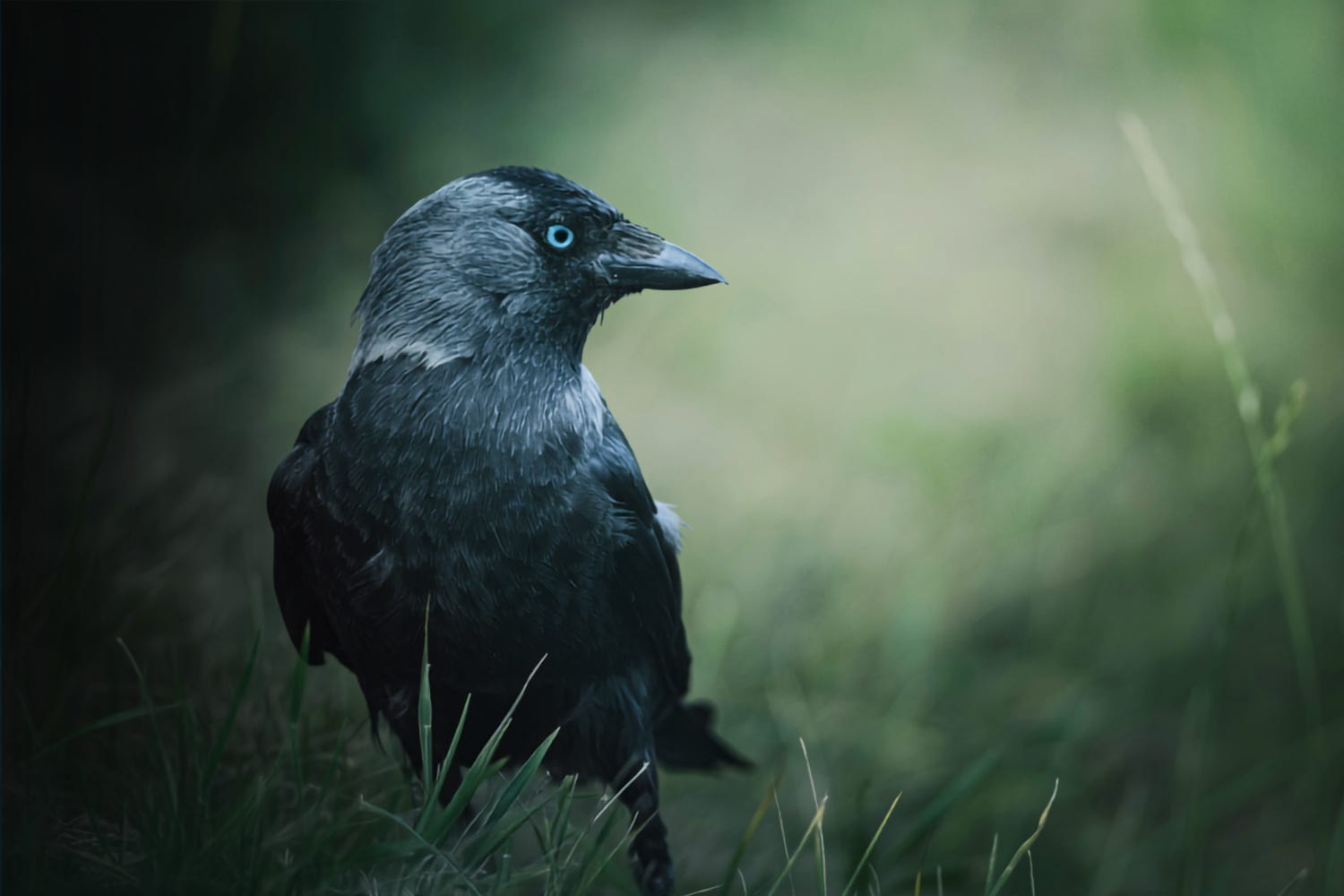
amber, obsidian, and bright blue eyes
perching on the horizon

Hello. This post is about Death & Birds.
I recently dreamt that I was kneeling in the fawns enclosure, positioning leafy branches as the young, curious Deer inspected both the foliage and myself, when I suddenly sensed that we were being watched. Looking towards the wall of wire fencing at the end of the enclosure—the one that backs onto the woods into which, one day, the fawns will be released—my blood ran cold as I saw, staring through the thicket, a large and piercing pair of amber eyes. I am often plagued by dreams, at this time of year, which speak to my fears for the animals we must release, to my heightened awareness of the danger, and predation, and potential suffering that exists on the other side of their relinquishment. And perhaps nevermore so than now, as we release each one into a world that is on fire.
It rained here, last week, for about half an hour. And it wasn’t enough, and it won’t make a dent in the waning rivers or bone-dry earth, but for those thirty minutes we hung out of windows like children, and we sighed a hundred sighs alongside every other drought-weary being lucky enough to have been caught in the downpour. For all my study, and all my practice, I do not know how to grieve what is happening, or how to doula this kind of dying—so amorphous the shape of it, so vast the scale. To love this life, to love the wild, is to love each of the countless beings to whom life and the wild belong. But, how to grieve the loss from inside an ongoing disaster with no clear or single trajectory? If someone we love has been hit by a car we do not stop; we act. But, what if at the same time another being we love has a car hurtling towards them? And another is on life-support? And another one just died? In which direction should we walk when every few seconds some fresh devastation insists itself due North?
As the end of baby season perches on the horizon, the number of releases climbs steadily. I had fourteen Birds in the car with me, last week—mostly Jackdaws, a few Thrushes, yet more Blackbirds and a Jay—all split between various carriers. When Jackdaws are young they (like my love) have bright, pale blue eyes, the colour of blue lace agate. As babies they scream to be fed—and I do mean scream. Their particular “feed me!” squawks can reach 90 decibels and they sound like something from a horror film. When I have my head and torso inside a bay containing two or more baby Jackdaws demanding to be fed, it is akin to being inside a struck bell and it is impossible to form a thought. You could ask me my name while I was inside, and I genuinely wouldn’t know it. On the drive home the Jackdaws became very chatty, which prompted everyone else to join in. It made for quite the cacophony inside an inclosed space and, once home, they set off into the wild, but not before settling on various branches and finishing their conversation. As with any release, a gossamer thread of my love and attention remains attached to each of them. By the end of the season a hundred of these threads extend upward, as though I am puppeteered by the sky. It will be unique, then, when the time comes, to have six four-legged beings toward whom my mind will orient insistently over the coming months and years.
The fawns have now reached the age where, after breakfast, they get the zoomies and they run at speed in loops. The collective noise of their twenty-four hooves sounds like a distant thunder. One of them, Michael, is unlike the rest in that, due to a benign genetic mutation, his coat is entirely chocolate brown, as opposed to the classic light tan with dappled white spots that the others wear. Michael is a sweet, gentle boy. His eyes are like globes of obsidian glass that reflect the object of his awareness—I feel as though I’d never really seen myself until I saw my reflection in them. There is a gravity to him that pulls me out of time, and he doesn’t hold my attention so much as he gives it permission to rest. Watching him feels like looking out to sea, there’s a sense of expansiveness to it—one that I dearly hope is reflective of his future, although, on the other side of that wire fence lie a thousand paths of potential. There is a world in which, a decade away, he is a formidable roaring stag, branching crown of bone propping up the entire sky as he roars steam into the Winters morning air. There is world in which he, on the day of his release, sees a car for the first time, freezes, and never sees a single Winter—and between those two worlds lie a thousand more, branching like his antlers one day will, or won’t. It seems to me, that the only response equal to the weight of this terrible not-knowing—whether Michael’s fate, or the Birds, or this madness and fire-riddled world’s—is a fierce, immovable, unrelenting, and unreasonable love. Offered without condition or restraint, while staring straight into the amber eyes of every car and every wildfire that sits on the other side of that fence.
Yours in aimless flight…
If you’re curious as to the sound that baby Jackdaws make, there’s a wonderful example HERE (I highly suggest that you turn your volume down!!)
And below you can watch some of the Jackdaws I brought home heading off into the wild. God speed, my loves:
And if you’re interested in re-relating to what it means to die, you are invited into:

Chloe, your fierce, immovable, unrelenting, and unreasonable love is so very inspirational and so very appreciated. May Michael and all the other babies live long and abundantly wild and wonderful lives.
They need to learn the laws of nature. Mother animals raise their young, teach them the important lessons of life and then they’re on their own.
If somehow you’ve given them a similar upbringing that’s all you can do.